
Selecting the right industrial grease in Thailand for heavy machinery is not just a routine maintenance decision — it directly impacts equipment lifespan, operational efficiency, and overall maintenance costs. In industries such as manufacturing, construction, mining, palm oil processing, cement plants, and logistics, machinery operates under extreme pressure, high loads, and continuous movement.
Thailand’s tropical climate adds another layer of complexity. High ambient temperatures, heavy rainfall, and humidity can affect grease stability, oxidation resistance, and water contamination levels. Choosing the wrong grease can lead to bearing failure, corrosion, overheating, and unexpected downtime.
This guide will help you make a more informed decision when selecting industrial grease for heavy-duty applications.
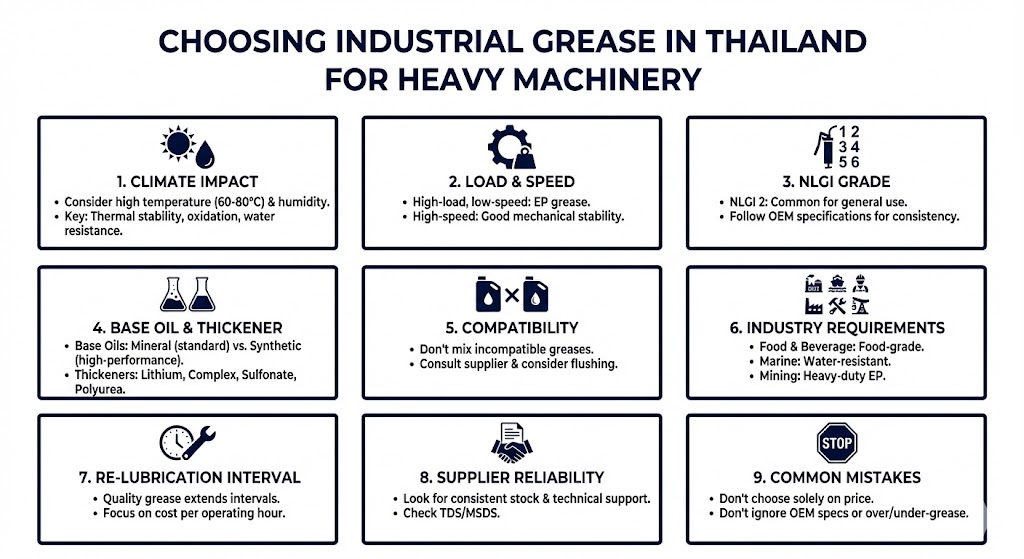
1. Understand Thailand’s Climate Impact on Grease Performance
Thailand’s average temperatures range between 30–35°C, and in industrial environments, machinery surface temperatures can exceed 60–80°C. In addition, high humidity increases the risk of moisture contamination.
When choosing grease, consider:
- Thermal stability – Can it maintain structure under high heat?
- Oxidation resistance – Will it resist breakdown over time?
- Water resistance – Can it protect bearings in wet environments?
- Corrosion protection – Does it prevent rust formation?
For industries such as marine, food processing, or outdoor construction, water-resistant grease (e.g., calcium sulfonate-based) is often recommended.
2. Identify Load, Speed & Pressure Requirements
Heavy machinery components operate under varying loads and speeds. The wrong grease can cause metal-to-metal contact, leading to rapid wear.
High-Load, Low-Speed Applications
Examples:
- Excavator pivot points
- Crusher bearings
- Press machines
These require Extreme Pressure (EP) grease with additives that protect against shock loads.
High-Speed Bearings
Examples:
- Electric motors
- Conveyor rollers
- Pumps
These require grease with:
- Good mechanical stability
- Low internal friction
- Heat dissipation properties
Understanding this difference ensures optimal lubrication performance.
3. Choose the Correct NLGI Grade
The National Lubricating Grease Institute (NLGI) grade determines grease consistency.
- NLGI 000–0 → Semi-fluid (enclosed gear systems)
- NLGI 1 → Soft grease (cold environments or centralized systems)
- NLGI 2 → Most common for industrial machinery
- NLGI 3 → Thicker grease for high-temperature or vertical shafts
In Thailand, NLGI 2 is widely used for general heavy machinery because it balances pumpability and stability. However, always follow OEM (Original Equipment Manufacturer) specifications.
4. Evaluate Base Oil Type & Thickener Technology
Not all greases are created equal. Their performance depends on formulation.
Common Base Oils
- Mineral Oil – Cost-effective, suitable for general applications
- Synthetic Oil – Superior temperature stability and longer service life
Thickener Types
- Lithium Grease – Versatile, widely used
- Lithium Complex – Higher temperature resistance
- Calcium Sulfonate – Excellent water resistance
- Polyurea – Ideal for electric motors
For high-performance or critical equipment, synthetic grease may reduce re-lubrication intervals and improve long-term cost savings.
5. Check Compatibility with Existing Grease
Mixing incompatible grease types can cause:
- Softening or hardening
- Oil separation
- Reduced lubrication performance
Before switching brands or formulations, consult your supplier for compatibility testing. Flushing old grease may be required in certain cases.
Working with experienced suppliers like Shinseika Industrial Co. Ltd. ensures proper technical consultation and product matching for your machinery.
6. Consider Industry-Specific Requirements
Different industries in Thailand require specialized grease solutions:
- Food & Beverage → Food-grade grease (NSF compliant)
- Automotive Manufacturing → High-speed bearing grease
- Marine & Ports → Water-resistant and anti-corrosion grease
- Cement & Mining → Heavy-duty EP grease
Choosing grease based on industry application reduces risk and increases reliability.
7. Assess Re-Lubrication Interval & Maintenance Strategy
High-quality industrial grease can:
- Extend lubrication intervals
- Reduce labor costs
- Minimize downtime
- Improve equipment lifespan
Instead of focusing solely on price per drum, evaluate cost per operating hour. Premium grease may cost more upfront but significantly lower total maintenance expenses.
8. Ensure Supplier Reliability & Technical Support
When sourcing industrial grease in Thailand, supplier reliability is just as important as product quality.
Look for:
- Consistent stock availability
- Technical data sheets (TDS & MSDS)
- On-site consultation support
- Industry certifications
- Custom lubrication recommendations
A reliable partner provides long-term value beyond just supplying lubricant products.
9. Avoid Common Purchasing Mistakes
Many companies make these errors:
- Choosing grease based only on price
- Ignoring OEM specifications
- Not considering operating temperature
- Mixing incompatible grease types
- Over-greasing or under-greasing equipment
Proper training and expert guidance can prevent costly equipment failure.
Final Thoughts
Choosing the right industrial grease in Thailand for heavy machinery requires careful evaluation of operating conditions, load requirements, grease formulation, and supplier expertise. With Thailand’s hot, humid climate and demanding industrial environments, selecting the correct lubricant is essential to prevent premature wear, overheating, corrosion, and costly downtime. A well-matched grease improves operational stability and ensures machinery performs consistently under heavy loads.
By investing in high-quality grease and working with an experienced supplier such as Shinseika Industrial Co. Ltd. businesses can enhance equipment lifespan, reduce maintenance frequency, and lower total operating costs over time. Proper lubrication is not just a maintenance task — it is a strategic decision that directly impacts productivity and long-term profitability.
Frequently Asked Questions (FAQs)
Most heavy machinery uses NLGI 2 lithium or lithium complex grease. For high loads or wet conditions, EP or water-resistant grease may be required. Always follow OEM recommendations.
It depends on operating hours, load, and environment. In Thailand’s hot and humid conditions, more frequent lubrication may be needed. Follow a preventive maintenance schedule.
No, mixing incompatible greases can cause performance issues like softening or oil separation. Always check compatibility before switching products.
A reliable supplier such as Shinseika (Thailand) Co., Ltd. provides proper technical advice, product documentation, and consistent supply to ensure optimal equipment performance.